What Is a Lay Bet on a Betting Exchange?
A lay bet is a wager that an outcome won't happen — letting you act as the bookmaker on a betting exchange. Here's how laying, liability and trading work.
Sports markets. Active offers appear first.
Choose a country to browse its offers.
Fractional odds are the traditional way of pricing bets in the UK and Ireland, and they still dominate horse racing worldwide. To a newcomer, a line like 9/4 or 2/5 can look baffling. But once the logic clicks, fractional odds are simple — and they tell you at a glance both your potential profit and how likely the bookmaker thinks an outcome is.
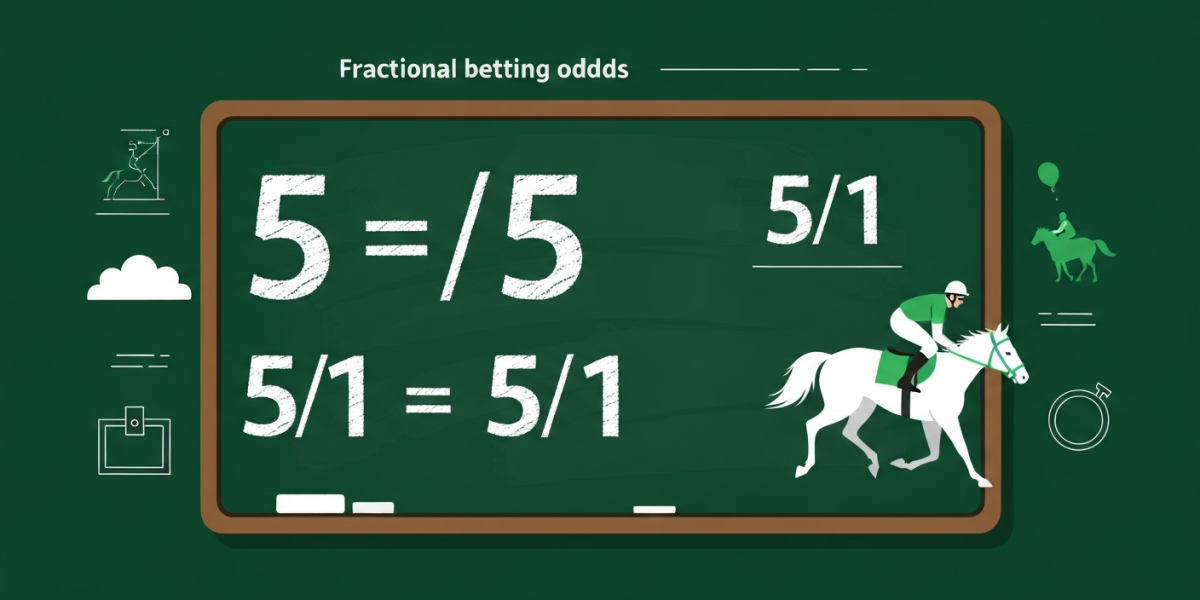
A fractional price is written as two numbers separated by a slash, such as 5/1 (said “five to one”). The rule is straightforward:
The first number is the profit you win; the second number is the stake you must risk to win it.
So 5/1 means you win 5 units of profit for every 1 unit you stake. Bet $10 at 5/1 and you win $50 profit. Bet $10 at 3/1 and you win $30 profit. The fraction is purely a profit-to-stake ratio.
A common beginner mistake is forgetting that your original stake comes back too when you win. Your total return is your profit plus your returned stake.
The formula for profit is simply: stake × (first number ÷ second number).
Sometimes the fraction is reversed, like 2/5 or 1/2. These are called “odds-on” prices and they signal a strong favourite. Here you have to risk more than you stand to win, because the outcome is considered very likely.
At 2/5, a $10 stake wins just $4 profit ($10 × 2 ÷ 5). At 1/2, a $10 stake wins $5 profit. You will still get your stake back on top, but the small profit reflects the low risk. Whenever the second number is bigger than the first, you are backing a favourite.
Fractional odds also encode how likely the bookmaker thinks an outcome is. To convert a price A/B into implied probability:
Implied probability = B ÷ (A + B) × 100
So 5/1 = 1 ÷ (5 + 1) = 16.7%. A 2/5 favourite = 5 ÷ (2 + 5) = 71.4%. Evens, written 1/1, = 1 ÷ 2 = 50%. This lets you compare the bookmaker’s view with your own and hunt for value.
Many sites let you switch between formats, and the two are interchangeable. A handy way to convert a fraction to decimal is (first ÷ second) + 1:
If mental maths with fractions feels slow, switching your account to decimal odds can make comparing prices much faster.
Fractional odds show profit over stake: the first number is what you win, the second is what you risk. Remember your stake returns on top, watch for odds-on prices where the favourite pays little, and use B ÷ (A + B) to turn any fraction into a probability. Master those three ideas and no racing price will ever confuse you again.
Check the bet structure alongside its quoted odds before interpreting a potential return.

A lay bet is a wager that an outcome won't happen — letting you act as the bookmaker on a betting exchange. Here's how laying, liability and trading work.

A bet builder combines several outcomes from one match into a single high-odds bet. Learn how bet builders work, correlation, and how to build smarter.
Asian handicap betting removes the draw and offers sharper odds. Learn how the handicap works, whole/half/quarter lines, and why it can beat standard markets.